
 XM
 Bybit
 Binance
 IC Markets
 Pepperstone
 OKX
 Vantage
 VT Markets
 BingX
 Gate.io
 Kucoin
 MEXC
 Exness
 Bitget

Understanding the Core Concept of Kraken
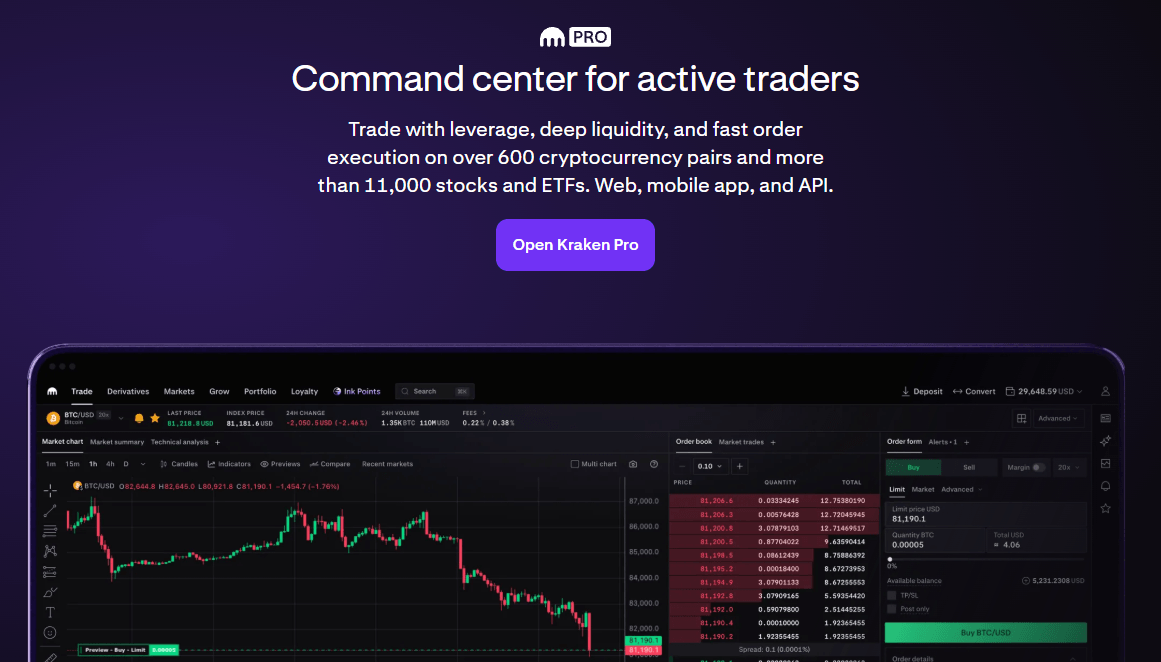
Kraken is a centralized digital-asset exchange and financial-services company. In plain terms, it is a regulated marketplace where buyers and sellers of cryptocurrencies are matched through an order book, and where the platform holds customer assets in custody while they are on the exchange. Unlike loan-matching or broker-style websites, Kraken operates its own trading infrastructure, its own matching engine, and, in the United States, its own banking subsidiary.
The platform is split into products designed for different types of users. The standard Kraken app is aimed at beginners who want to buy and sell crypto and stocks with a simple interface and recurring purchases. Kraken Pro is the advanced trading terminal for active traders, with a full order book, leverage, advanced order types, and an API. Kraken Wallet is a self-custody wallet for DeFi access, Krak is a global money app with a spending card, and Kraken Prime serves institutions with OTC trading and custody.
At Finance-Solutes.com, we view Kraken as a “full-stack” exchange rather than a single-feature broker. That breadth is its main attraction, but it also means traders must understand which product they are using, because fees, available markets, and protections can differ between the beginner app and the Pro terminal, and between countries.
The Company Behind the Platform
Kraken was founded in 2011 by Jesse Powell, reportedly inspired by the security failures that brought down the Mt. Gox exchange. The platform is operated by Payward, Inc., and has since expanded through acquisitions and new licenses into multiple regions. Its homepage describes the platform as trusted by millions of clients worldwide, and independent reviewers estimate its user base at more than 15 million traders.
Kraken’s positioning is built around trust and compliance. In March 2026, its Wyoming-chartered banking subsidiary, Kraken Financial, received a limited-purpose Federal Reserve master account from the Federal Reserve Bank of Kansas City, which was widely reported as the first time a crypto-focused bank gained direct access to the Fed’s payment system. The account was granted for an initial one-year term with restrictions, and it drew criticism from banking trade groups and some lawmakers, so it is best understood as a notable milestone rather than a guarantee of safety for customer funds.
Kraken Products and Services
Kraken’s product line has widened significantly in recent years. Depending on your country, the platform can serve as a single account for several different financial activities, which is a meaningful convenience for users who would otherwise juggle multiple apps.
Core Trading and Earning Features
- Spot Crypto Trading: Buy and sell major coins such as Bitcoin, Ethereum, XRP, and Solana against fiat currencies and other crypto assets, with more than 600 crypto pairs available on Kraken Pro.
- Stocks and ETFs: Kraken advertises access to more than 11,000 stocks and ETFs on Kraken Pro, with U.S. brokerage services provided by Kraken Securities LLC, a FINRA and SIPC member. Availability is limited to the United States and certain states.
- Tokenized Equities (xStocks): Tokenized versions of popular stocks and ETFs, available in selected regions.
- Margin and Futures: Leveraged spot margin and crypto perpetual futures for experienced traders, with Kraken advertising up to 20x regulated spot margin for eligible U.S. traders. Eligibility and leverage limits vary by country.
- Staking and Earning: Staking rewards and APY on selected assets, subject to geographic restrictions. Rewards are variable and not guaranteed.
- Recurring Buys: Automated dollar-cost-averaging purchases for long-term investors.
- Kraken Wallet: A self-custody wallet for deposits, earning, and DeFi activity on web and mobile.
- Krak Card and Money App: A spending product that lets users spend crypto or cash at merchants worldwide and send money across borders.
- API and CLI Trading: Developer tools for automated strategies, including a command-line tool marketed for AI agents.
- Prime and OTC: Institutional brokerage, large-block OTC trades, and custody services.
Who Each Product Is For
- Beginners: The standard Kraken app, with simple buy and sell flows and recurring purchases.
- Active Traders: Kraken Pro, with the order book, advanced orders, margin, futures, and API access.
- Self-Custody Users: Kraken Wallet, for people who prefer to hold their own keys.
- Institutions and High-Net-Worth Clients: Kraken Prime and VIP services.
Kraken at a Glance: A Quick Overview
Because Kraken operates in many jurisdictions, some details differ by country and by product. The table below summarizes the general parameters that apply to the platform as a whole, based on Kraken’s own materials and independent reviews:
| Parameter | Details |
|---|---|
| Service Type | Centralized crypto exchange and financial platform |
| Operator | Payward, Inc. |
| In Operation Since | 2011 |
| Products | Spot, margin, futures, staking, stocks and ETFs (selected regions), tokenized equities, wallet, card |
| Trading Terminal | Kraken Pro (web, mobile, API) |
| Markets | 600+ crypto pairs and 11,000+ stocks and ETFs on Kraken Pro (per Kraken) |
| Fee Model | Maker/taker tiers on Kraken Pro; fixed fee plus spread on the standard app |
| Cold Storage | Around 95% of client crypto reported to be held offline |
| Proof of Reserves | Published regularly with independent verification |
| Key Regulatory Footprint | U.S. (FinCEN, Wyoming SPDI bank), Canada (FINTRAC), UK (FCA), Australia (AUSTRAC), EU (MiCA), UAE (VARA) |
| Account Verification | Required (KYC) |
| Deposit Insurance | Crypto and cash balances are not FDIC insured |
It is especially important to focus on the live fee schedule and the regulatory status that apply to your own country and your own product. Kraken lists different entities and licenses for different regions, and the protections available to a customer in one jurisdiction may not exist in another. Always confirm which Kraken entity will hold your account before you deposit funds.
Kraken Fees: What You Actually Pay
Kraken uses two broad pricing systems, and understanding the difference is one of the most useful things a new user can do. The standard app charges a fixed percentage fee on instant buys and sells, and the quoted price also includes a spread, which means the total cost of a simple purchase is typically higher than on the Pro terminal. Independent reviewers generally put the effective cost of the beginner app in the range of roughly 1% to 1.5% or more per trade, depending on the order type and payment method.
Kraken Pro uses a maker/taker schedule that declines as your 30-day trading volume grows. Makers add liquidity with limit orders that rest on the order book, while takers remove liquidity by matching existing orders. Futures fees are much lower than spot fees, and high-volume traders can reach very low or even zero maker fees. Note that Kraken has adjusted its fee tiers during 2026, and several reviews published at different times quote different entry-level rates, so always read the current fee schedule on Kraken’s website rather than relying on a number printed in a review.
Other costs to watch for include deposit and withdrawal fees, which vary by method and country. Card deposits are typically more expensive than bank transfers, and some sources report card fees of around 3.75% plus a small fixed amount. Kraken states that it does not charge account maintenance or inactivity fees, and many bank transfers can be free.
Security and Safeguards
Security is the single biggest reason serious traders choose Kraken. The exchange has built its reputation on conservative custody practices and a long operating history without a major exchange-level hack reported by reviewers.
Key Security Features
- Cold Storage: Roughly 95% of client crypto is reported to be stored offline in air-gapped, geographically distributed storage.
- Proof of Reserves: Kraken publishes reserve attestations that let users verify their holdings are backed, using independent review.
- Two-Factor Authentication: Strong 2FA options, withdrawal confirmations, and account-level security settings.
- Security Audits: Independent reviewers report SOC 2 and ISO 27001 certifications.
- Segregated Banking Arm: In the U.S., Kraken Financial operates as a Wyoming special purpose depository institution with a full-reserve model.
The April 2026 Insider Incident
No review of Kraken would be balanced without mentioning the incident disclosed in April 2026. Kraken reported that two separate cases of improper access by support staff exposed limited customer data, followed by an extortion attempt by a criminal group threatening to release internal videos. Reports at the time put the number of affected accounts at around 2,000, which Kraken described as roughly 0.02% of its client base. The company stated that its systems were not breached, that passwords, private keys, and funds were not exposed, and that it would not pay the extortion demand.
This episode shows that even well-secured exchanges can be vulnerable to insider and social-engineering risks, and that the data held by a platform, such as names, emails, and phone numbers, can be targeted even when funds are safe. For users, the practical lesson is to expect phishing attempts, to be suspicious of any unsolicited contact claiming to be from Kraken, and to use unique passwords and strong 2FA.
Regulation and Legal Standing
Kraken is licensed or registered in numerous jurisdictions, which is one of its strongest selling points compared with offshore exchanges. Independent reviewers list oversight and registrations in the United States (including FinCEN registration and a Wyoming bank charter), Canada (FINTRAC), the United Kingdom (FCA), Australia (AUSTRAC), the European Union (MiCA authorization, with Irish supervision), and the United Arab Emirates (VARA). In the United States, its brokerage arm is a FINRA and SIPC member for equities.
The regulatory record is not spotless, and a responsible review should say so. In 2023, Kraken agreed to pay a $30 million penalty to settle U.S. regulatory action and shut down its U.S. crypto staking service at the time. In 2024, the Federal Court of Australia fined Kraken A$8 million for unlawfully offering a margin extension credit facility to retail customers. These cases show that the platform operates in a heavily scrutinized environment, and that products and availability can change quickly as regulators set new rules.
Eligibility Requirements for Kraken
To open and use a Kraken account, users must complete identity verification and live in a supported jurisdiction. Verification levels determine deposit, withdrawal, and trading limits, and the most advanced features, such as margin and futures, require extra eligibility checks.
Basic Eligibility Criteria
- Age: Must be at least 18 years old.
- Supported Location: Must live in a country or state where Kraken offers services. Kraken restricts or excludes some regions, and certain products are unavailable in specific countries.
- Identification: A valid government-issued ID and, depending on the verification level, proof of address.
- Contact Information: A valid email address and phone number for account security and 2FA.
- Funding Method: A bank account, card, or crypto wallet to deposit funds.
- Advanced Product Checks: Margin, futures, and some earning products require additional eligibility and risk acknowledgments.
Why Traders Choose Kraken
Despite operating in a competitive market alongside Coinbase, Binance, Gemini, and Bitstamp, Kraken has maintained a loyal following thanks to several practical advantages that resonate with both new and experienced traders.
Key Strengths of the Platform
- Long Operating History: More than a decade in business gives Kraken a track record that many newer exchanges cannot match.
- Strong Security Reputation: Heavy use of cold storage, regular proof-of-reserves reporting, and no major exchange hack reported by reviewers.
- Broad Regulatory Coverage: Licenses and registrations across several major financial jurisdictions.
- Competitive Pro Fees: Kraken Pro is widely viewed as cost-effective for active traders, especially at higher volumes and for futures.
- One Account, Many Markets: Crypto, stocks and ETFs, futures, staking, and a wallet can be accessed through a single ecosystem in supported regions.
- Deep Liquidity on Major Pairs: Reviewers highlight strong liquidity on major fiat and crypto pairs.
- Developer Tools: A mature API and command-line tooling for algorithmic traders.
Customer Support and Accessibility
Kraken provides a searchable Support Center, a public status page, and a formal complaint-handling process for questions about accounts, deposits, and trading. Account verification and support response times are among the most common complaints in independent reviews, particularly during busy market periods or when manual review is required, so new users should complete verification before they need to trade or withdraw in a hurry.
Because Kraken is available in many countries, the quality and speed of support, as well as the funding methods available, can differ depending on where you live. It is wise to read the support articles for your own region before depositing significant funds.
What to Consider Before Using Kraken
While Kraken is considered one of the more reputable exchanges in the industry, Finance-Solutes.com strongly encourages readers to remember that cryptocurrency trading is high risk. Prices can move sharply in a short time, leveraged products can magnify losses beyond your initial deposit, and no exchange can remove market risk.
Potential Drawbacks to Be Aware Of
- Higher Costs on the Beginner App: Instant buys include a fixed fee and a spread, which makes the standard app noticeably more expensive than Kraken Pro.
- Fee Schedule Changes: Fee tiers have been adjusted in 2026, so older review figures may be out of date.
- No Deposit Insurance: Crypto and cash balances on the platform are not FDIC insured, and Kraken Financial is not covered by the FDIC.
- Insider and Data Risk: The April 2026 incident showed that customer data can be exposed through insider access even when funds remain safe.
- Verification Delays: Some reviewers report slow verification, especially for advanced accounts.
- Limited Newer Altcoins: Reviewers note Kraken lists fewer newly launched tokens than some larger competitors.
- Regional Restrictions: Many products, including some staking, futures, and tokenized stock offerings, are unavailable in specific countries and U.S. states.
- Regulatory History: Past penalties in the United States and Australia show that product availability can change when rules change.
- Leverage Risk: Margin and futures can lead to rapid liquidation and losses larger than expected.
Responsible Trading Checklist
- Only Invest What You Can Afford to Lose: Crypto is volatile, and prices can fall dramatically without warning.
- Use Kraken Pro for Active Trading: The standard app is convenient but usually more expensive for frequent trades.
- Check the Live Fee Schedule: Confirm current maker/taker rates, spreads, and deposit and withdrawal fees before you trade.
- Enable Strong 2FA: Use an authenticator app or hardware key, and add withdrawal protections wherever they are offered.
- Beware of Phishing: Only use the verified Kraken.com domain and never share your password, 2FA codes, or recovery phrases with anyone claiming to be support.
- Understand Leverage Before Using It: Start without margin, learn how liquidation works, and use stop-loss orders.
- Consider Self-Custody for Long-Term Holdings: Assets you do not plan to trade can be moved to a hardware wallet that you control.
- Keep Records for Taxes: Trades, staking rewards, and transfers may be taxable in your country, so keep clear records and seek independent advice.
How Kraken Compares in the Crypto Exchange Market
The global exchange market is highly competitive, with Coinbase, Binance, Gemini, and Bitstamp among Kraken’s most frequently cited rivals. Coinbase is generally viewed as the easiest on-ramp for beginners but tends to charge higher fees. Binance offers a very large number of listed assets and lower headline fees but operates under a different regulatory profile in many regions. Gemini and Bitstamp emphasize compliance and simplicity, with narrower product ranges.
Kraken occupies a middle ground that many serious traders find attractive: a strong compliance and security reputation, professional tools on Kraken Pro, and a growing set of products that go beyond crypto. For a casual user making a few small purchases, the standard app is convenient but not the cheapest option. For an active trader who values regulation, deep liquidity on major pairs, and a mature API, Kraken is often shortlisted. As with any exchange, the best choice depends on your country, the assets you want to trade, and how much you value fees versus features.
How to Open a Kraken Account
Opening an account is straightforward, though identity verification can take time. Below is a step-by-step overview of what to expect:
- Step 1: Visit the official Kraken.com website through a secure connection, or download the official app from a trusted app store.
- Step 2: Click the sign-up button and register with your email address or a supported social sign-in option.
- Step 3: Create a strong, unique password and confirm your email address.
- Step 4: Complete identity verification by providing your personal details and uploading a valid government ID.
- Step 5: Enable two-factor authentication using an authenticator app or security key.
- Step 6: Deposit funds using a bank transfer, card, or crypto transfer, after reviewing the fees for your chosen method.
- Step 7: Choose your interface, either the standard Kraken app for simple purchases or Kraken Pro for the full trading terminal.
- Step 8: Place your first order, preferably starting with a small amount and a limit order to control price and cost.
Final Verdict on Kraken
Kraken is one of the most established and best-regulated crypto exchanges available today, and it offers a genuinely broad set of tools for a wide range of users, from first-time buyers to professional traders. Its combination of conservative custody practices, regular proof-of-reserves reporting, wide regulatory coverage, competitive Pro-level fees, and a growing product suite makes it a strong candidate for anyone who prioritizes trust and transparency over chasing the newest tokens.
However, prospective users should approach Kraken with clear eyes. The standard app can be expensive for frequent trading, fee schedules have been changing, client balances are not covered by deposit insurance, and the April 2026 insider incident is a reminder that data security extends beyond the safety of funds. The platform has also faced regulatory penalties in the past, and the availability of products depends heavily on where you live.
At Finance-Solutes.com, we believe Kraken is best suited for traders who understand crypto risk, value regulation and security, and are willing to learn the difference between the beginner app and the Pro terminal. As with any exchange, the key to a good outcome is discipline: use strong security, understand every fee before you trade, avoid leverage until you truly understand it, and never invest money you cannot afford to lose.
Risk Warning: This article is for informational purposes only and does not constitute financial, investment, or trading advice. Cryptocurrency and leveraged products carry a high level of risk and may not be suitable for everyone. Product availability, fees, and regulatory status vary by country and can change at any time. Always check Kraken’s current terms and conduct your own research before depositing funds.
 Create your account to get started: https://kraken.pxf.io/L04RzY
Conclusion
Kraken has established itself as one of the leading global crypto exchanges, combining more than a decade of operating history, a strong security and compliance reputation, a professional trading terminal, and a growing ecosystem that spans crypto, stocks, futures, staking, and spending. With broad regulatory coverage, regular proof-of-reserves reporting, and competitive fees on Kraken Pro, the platform offers a solid foundation for both new and experienced traders. Because costs differ sharply between the beginner app and the Pro terminal, because fee schedules and product availability change over time, and because no exchange can remove market risk or guarantee protection against every security threat, the value of Kraken depends largely on how carefully it is used. As always, Finance-Solutes.com encourages readers to verify the live fee schedule, secure their accounts with strong 2FA, trade with sensible position sizes, consider self-custody for long-term holdings, and treat crypto as a high-risk asset rather than a guaranteed source of returns.
Watch More
- t.me/finance_solutes
- Website: https://finance-solutes.com
- Hotline: +1 929 5636 439 ( Hotline )
- 26 Broadway, Suite 934, New York, 10004, US
