

What is the Ethereum Virtual Machine (EVM)? How Does the EVM Execute Smart Contracts?

As a cryptocurrency investor, you’ve likely heard of Ethereum (ETH)—the second-largest cryptocurrency by market capitalization. Like most cryptocurrencies, ETH is associated with both digital assets and blockchain technology. Moreover, this network is a blockchain specifically designed for smart contracts. This allows developers to create programs using Smart Contracts for various purposes, including decentralized applications (dApps). The Ethereum Virtual Machine (EVM) is the backbone that makes this possible.

So, what exactly is the EVM? How does the EVM function? What are its advantages and limitations? Let’s dive into the details with Forex in today’s article.

1. WHAT IS THE ETHEREUM VIRTUAL MACHINE (EVM)?

In this section, let’s explore what the Ethereum Virtual Machine (EVM) is and how it operates.

1.1 Definition of the EVM

The term Ethereum Virtual Machine (EVM) refers to a virtual environment designed to execute the Bytecode of smart contracts.

Similar to most other blockchains, Ethereum relies on thousands of participants running software on their computers to support the network. Each Node (essentially a computer) in the network operates the EVM and executes smart contracts. To perform any task on this virtual machine, you need to pay a fee known as the Gas Price. However, instead of paying in conventional currency, you must use a specific cryptocurrency native to the Ethereum network.
Understanding simply, the EVM acts as an intermediary for executing smart contracts on the Ethereum network. Each Ethereum Node is equipped with its own EVM, ensuring the network’s security and decentralization.

1.2 How Does the Ethereum Virtual Machine Operate?

Investors often think of Bitcoin as a distributed ledger that enables decentralized currencies using basic cryptographic tools.

Practical Example: A BTC address cannot spend more BTC than it has received. This rule underpins all Bitcoin transactions and many other blockchains in the cryptocurrency market.

While Ethereum’s cryptocurrency (ETH) adheres to similar fundamental principles, it also enables a more powerful functionality: Smart Contracts. This more complex feature naturally requires a more sophisticated algorithm. Unlike Bitcoin’s distributed ledger, Ethereum functions as a Distributed Machine State.

The state of Ethereum is a large data structure that contains not only all accounts and balances but also the machine state. This state can change from one block to another based on predefined rules and the ability to execute arbitrary machine code. These specific rules for transitioning between blocks are defined by the EVM.
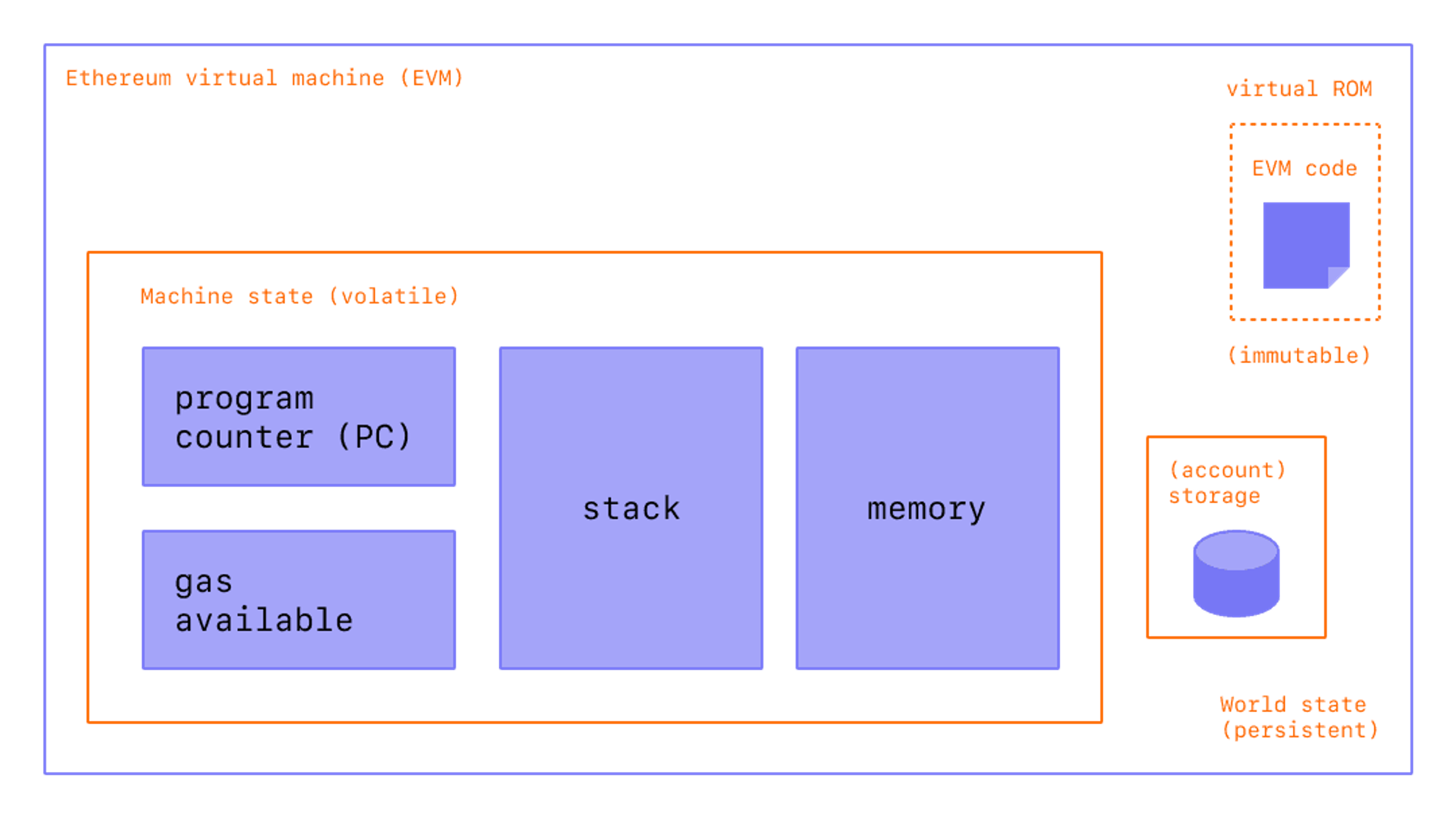
When functioning, the EVM operates like a mathematical function: given an input, it produces a defined output. This makes it a highly effective solution for describing Ethereum’s state-transition functionality.

2. WHAT IS AN EVM BLOCKCHAIN?

The term EVM Blockchain refers to blockchains that are compatible with the Ethereum Virtual Machine. This compatibility means that smart contracts from the Ethereum network can also run on these blockchains. In other words, with minor adjustments, decentralized applications (dApps) built on Ethereum can operate seamlessly on EVM blockchains.

Examples of EVM Blockchains: Celo, Fantom, Binance Smart Chain (BSC), etc.

Currently, Ethereum is the leading ecosystem, hosting hundreds of projects, with a Total Value Locked (TVL) of $197 billion, accounting for over 65% of the DeFi market. This makes it a fertile ground, attracting many other blockchains to “bridge” to its network.
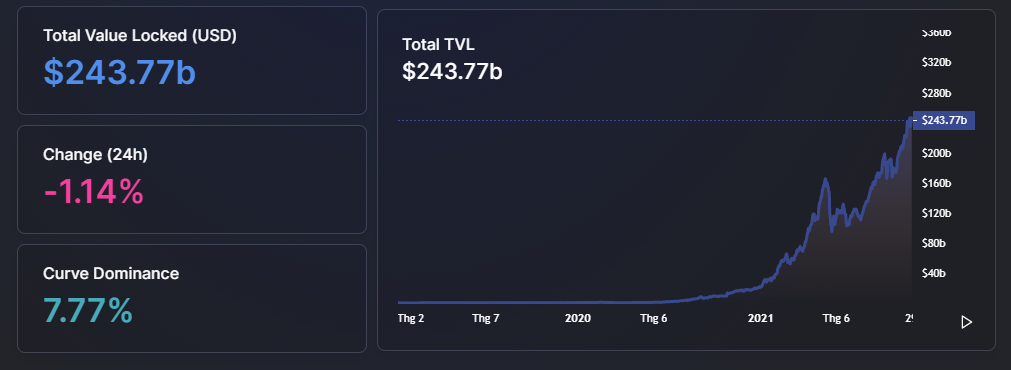

TVL trong các cầu nối chuỗi chéo DeFi đạt 22,48 tỷ đô la, tăng 48% trong 30 ngày

2.1 User Experience

The EVM provides several notable benefits for users:

User-Friendly Experience

For those who have used decentralized applications (dApps) on the Ethereum network, transitioning to products on EVM-compatible blockchains is seamless. This is because developers often retain the same interfaces and functionalities, ensuring familiarity and ease of use.

Transaction Speed and Gas Fees

Currently, Ethereum faces limitations such as high transaction fees (which can reach up to $100 during network congestion) and slow transaction speeds. These issues directly impact user experience.

However, newer blockchains address these challenges with more advanced technologies, effectively resolving the shortcomings of the Ethereum ecosystem. When these blockchains are EVM-compatible, their scalability is further enhanced, providing faster and more affordable transactions.

2.2 Benefits for Developers

Cách Trả Lời Điểm Mạnh Của Bản Thân Khi Phỏng Vấn

Here are some key advantages EVM offers developers:

No Extensive Learning Curve

Whether you’re a new developer or an experienced one, learning a new programming language can be time-consuming. However, with EVM technology, developers can easily work across different blockchains without needing to master a completely new language.

Scalability of Products

Instead of being restricted to a single blockchain, products can expand to other blockchains. This scalability allows developers to grow their brand and attract a larger user base.

Brand Recognition

When projects are deployed on multiple blockchains, their interfaces can either remain the same or be adjusted based on the project’s requirements. This means teams don’t need to create entirely new projects from scratch. A few tweaks are enough to launch their applications on EVM-compatible blockchains, boosting brand visibility across platforms.

3. EVM BLOCKCHAINS IN THE CURRENT CRYPTO MARKET

In this section, let’s explore some of the EVM blockchains currently available in the cryptocurrency market.

3.1 Binance Smart Chain (BSC)

Binance Smart Chain (BSC) là gì? Tìm hiểu về BSC và token BSC

This is a prime example of an EVM Blockchain that has achieved significant success, boasting over $22 billion in TVL value.

The BSC ecosystem currently hosts over 900 decentralized applications (Dapps), including more than 50 DEX projects. Notably, BSC’s greatest success lies in the DEX project PancakeSwap, with a TVL exceeding $8 billion.

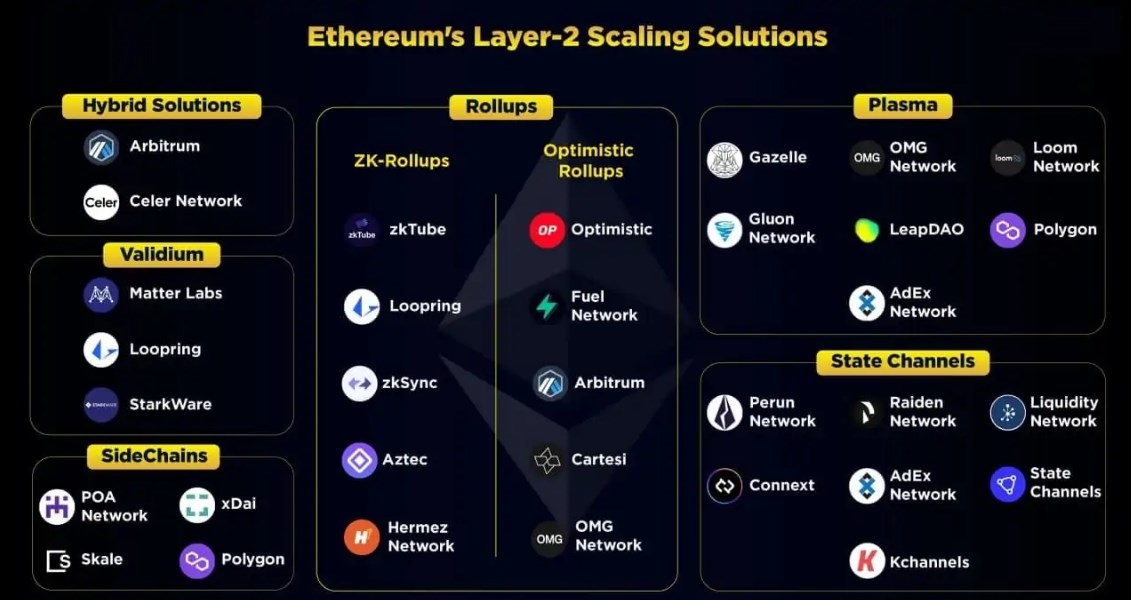
3.2. Layer 2 Solutions

It is evident that Ethereum’s Layer 2 ecosystem has achieved notable success as projects on Ethereum can deploy their platforms on these solution layers. This contributes to the overall development of the Ethereum ecosystem and the advancement of Layer 2 projects in particular.

3.3. Polygon

Polygon was created with the goal of being a Layer 2 solution to address Ethereum’s limitations, such as transaction speed and gas fees. However, currently, the Polygon network pays transaction fees in MATIC (Polygon’s native token), which makes it a separate blockchain from the Ethereum network.

The NFT marketplace OpenSea is a prime example of Polygon’s success. Initially developed on Ethereum, OpenSea has achieved notable success, with its trading volume in August 2021 reaching nearly $3.5 billion on Ethereum, and $50 million on Polygon. Therefore, we can see that OpenSea has begun to expand its market share and focus more on customer benefits when using the Polygon network instead of Ethereum.

Hoạt động mạng Polygon tăng trưởng mạnh trong quý 02/2022 bất chấp điều kiện thị trường

4. LIMITATIONS OF EVM BLOCKCHAIN

Although many of Ethereum’s ecosystem limitations have been addressed, EVM Blockchain still has several drawbacks as follows:

4.1. Fragmented Liquidity

When a project is available across multiple blockchains, its liquidity is only confined to the individual blockchain and cannot be linked across them. Even though there are “bridges” to transfer tokens between blockchains, these come with limitations in terms of fees, transfer time, and security risks. Additionally, DeFi applications with low liquidity can have a significant impact on user experience and benefits.

4.2. Risk of Hacker Attacks and Reduced Security

EVM is known as a technology that allows projects to deploy on multiple blockchains. However, if a cross-chain attack occurs, as seen in the Polynetwork incident in August 2021, it can lead to significant losses.

4.3. Increasing Number of Smart Contract Audits Across Multiple Blockchains

You may not know that the cost of auditing smart contracts is becoming increasingly expensive as projects seek to build their reputation.

According to Ulam, a company that partners with Algorand, the cost of auditing a contract on the Ethereum ecosystem can range from $7,500 to $45,000, and some companies may even charge up to $100,000.

5. SUMMARY

In this article, Forex has shared detailed information regarding what EVM is, how the Ethereum Virtual Machine operates, several EVM Blockchains currently available in the Crypto market, and the limitations of the EVM technology. We hope that the information we’ve provided will help you in your process of understanding and researching this new technology.

If you have any questions, feel free to leave a comment below, and we will respond promptly.

Wishing you success in your trading career!

🌍 Finance Solutes
  • t.me/finance_solutes
  • Website: https://finance-solutes.com
  • Hotline: +1 929 5636 439 ( Hotline )
  • 26 Broadway, Suite 934, New York, 10004, US